The tight electrostatic control in multi-gated nanowire field effect transistor (FET)1–4 makes it one of the most promising candidates for further scaling of silicon technology in sub-5 nm technology nodes, and is being actively pursued by the semiconductor industry5,6. The possible vertical integration of multiple nanowires enhances the drive current at a given footprint6,7. In parallel, several high-mobility, non-silicon channel options are being actively pursued as well, particularly for the p-FET8–10.
Three technological roadblocks must be overcome to achieve these high-performance, ultra-scaled devices. First, the source-drain electrical isolation in a transistor is usually achieved by doping. The required spatial steepness of the doping profile is non-trivial to achieve in such ultra-short channel nanowire FETs. It also adds to the large variability, resulting in low yield. In this direction, junctionless FET has attracted a lot of attention for high scalability11,12 where one uses a narrow conducting channel, and the gate voltage is used to deplete the carriers from the channel to turn it off, thus avoiding source-drain junction formation through ion implantation. Second, since the nanowire must be very narrow to achieve the required gate control, the surface roughness scattering is enhanced13,14, significantly degrading the carrier mobility. A nanowire channel with a dangling-bond-free surface will be ideally suited to reduce such mobility degradation. Third, as the device footprint goes down with transistor scaling, the effective contact area at the source and drain reduces. This increases the fraction of the contact resistance in the total transistor resistance under on condition, which is detrimental to the overall drive current, switching speed, current saturation, and output resistance15. One must use novel techniques to reduce contact resistivity.
In an attempt to address the above-mentioned issues, this chapter presents a dual-gated tellurium (Te) nanowire junctionless transistor. The unique chiral nature of the nanowire crystal structure16,17 allows a high hole mobility due to a dangling-bond-free surface, and its low electron affinity helps us to achieve zero Schottky barrier at the contact interface, reducing the contact resistance. We achieve a drive current of \(216\,\mathrm{\mu A/\mu m}\) with an on-off ratio of \(> 2\times 10^4\) and a high hole mobility of \(570\,\mathrm{cm^{2}/V\cdot s}\).
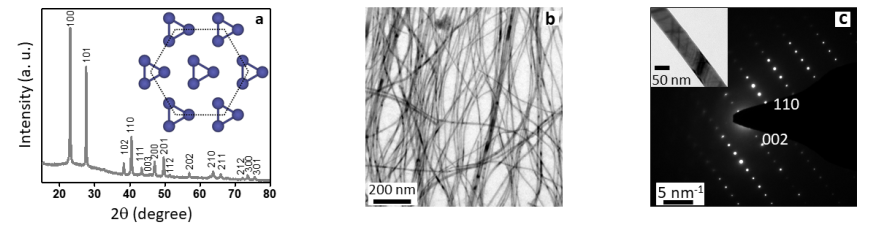
Te is an element in the chalcogen group, and its crystal structure consists of covalently bonded one-dimensional chains of Te along the c-axis that are held together by weak van der Waals interactions [inset of Figure 1.1(a)]. Thus, the nanowire form of Te is predominantly bound by lower energy surfaces that are produced by only breaking the weak van der Waals bonds and not the strong covalent bonds, leading to the dangling-bond-free surface of the nanowire. This unique anisotropic crystal structure of Te provides an opportunity to synthesize nanowires of Te down to single chain Te atoms17,18.
Tellurium, in its bulk form, has a bandgap of 0.35 eV and exhibits p-type nature19 with high carrier mobility20. As the bulk Te is reduced to smaller dimensions, it starts exhibiting an indirect bandgap of about 0.6 eV17,21. In addition to these electrical properties, Te also shows remarkable optical, thermoelectric, and piezoelectric properties22–25.
The Te nanowires are synthesized21 using \(\mathrm{Na_{2}TeO_{3}}\) as a precursor in the water medium, where hydrazine hydrate is used as a reducing agent, Polyvinylpyrrolidone( PVP) as a capping agent, and Ammonia is used to maintain proper pH. In a typical experiment, 1 g of PVP (average. M.W.= 58,000) is dissolved in 20 ml of DI water and 92 mg \(\mathrm{Na_{2}TeO_{3}}\) is dissolved in 15 ml DI water separately. Both solutions are mixed at room temperature. Into the above solution, 1.5 ml of Hydrazine hydrate and 3.3 ml of 25% aqueous ammonia solution are added drop-wise with moderate stirring. The transparent solution is then transferred to a 50 ml capacity teflon container. Then the hydrothermal reaction is allowed to take place for 4 hours at \(180\mathrm{^{\circ}C}\). After the reaction vessel cools down to room temperature, the solution is cleaned twelve times using hot water (\(60^{\mathrm{\circ}}\mathrm{C}\)) at 8000 revolutions per minute and subsequently two times using ethanol.
Synthesized Te nanowires have been characterized by X-ray diffraction (XRD) using a Rigaku X-ray Diffractometer with Cu \(\mathrm{K}\alpha\) source. Figure 1.1(a) represents the XRD pattern of the nanowire which corresponds to the rhombohedral phase (\(\mathrm{P3_{1}21}\)) of Te (JCPDS : 361452) with lattice parameters of \(\mathrm{a=b=4.45\,\mathring{A}}\), \(\mathrm{c=5.9\,\mathring{A}}\)). Transmission electron micrograph (TEM) in Figure 1.1(b) shows the one-dimensional morphology as well as the diameter distribution of the nanowires. The nanowires have an average diameter of 50 nm and a length of tens of micrometres. The selected area electron diffraction (SAED) pattern captured from one such nanowire is shown in Figure 1.1(c) which suggests the single-crystalline nature of the nanowire. The diffraction spots correspond to [\(1\bar{1}0\)] zone axis pattern and can be matched to (\(002\)) and (\(110\)) reflections of Te. The lattice fringes in the high-resolution TEM image in Figure 1.2(a) confirm the growth direction to be [001]. The high-angle annular dark field (HAADF) STEM image of the nanowire is shown in Figure 1.2(b), where the atomic layers of Te are clearly visible.
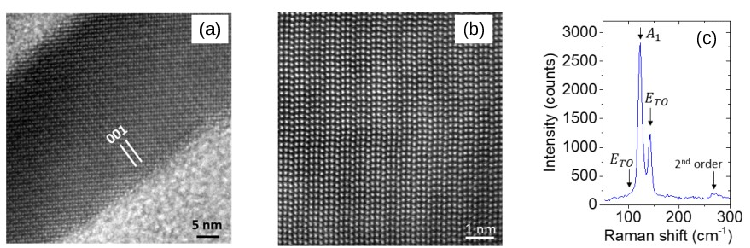
The nanowires exhibit a strong Raman peak [Figure 1.2(c)] at \(122.8\,\mathrm{cm^{-1}}\) corresponding to the \(A_1\) mode of lattice vibration at the Brillouin zone center26,27. The \(E_{TO}\) zone centre modes of vibration manifest as another strong Raman peak at \(142.6\,\mathrm{cm^{-1}}\) and a weak shoulder around \(103\,\mathrm{cm^{-1}}\)26,28. We assign the broad peak around \(265\,\mathrm{cm^{-1}}\) to second order Raman peak corresponding to \(A_1+E_{TO}\) two-phonon process29.
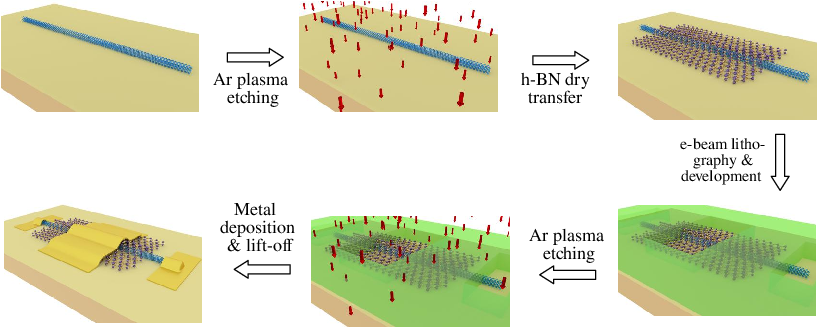
The step-by-step fabrication process of the junctionless FET is illustrated in Figure 1.3. We drop cast the Te nanowires onto a degenerately doped Si substrate coated with 285 nm thick, thermally grown, high quality \(\mathrm{SiO_{2}}\). A low-power Ar treatment is then performed to remove any residual PVP coating from the nanowires. A thin layer of high-quality hBN (\(\sim\) 15 nm) is immediately transferred onto the nanowire using a dry transfer technique30 to define the top gate dielectric. The atomically smooth surface of the dangling-bond-free hBN gate dielectric provides an ideal interface with the dangling-bond-free Te nanowire channel.
Subsequently, electron beam lithography is performed to define the source, the drain, and the gate metallization areas. To remove any unintentional residue and surface oxidation31 from the source/drain region of the nanowire, a second plasma cleaning step is performed, which improves the contact interface quality. Ni/Au is then deposited using DC magnetron sputtering, followed by lift-off in acetone to complete the device fabrication. More details of the fabrication are provided in Appendix [a01_00].
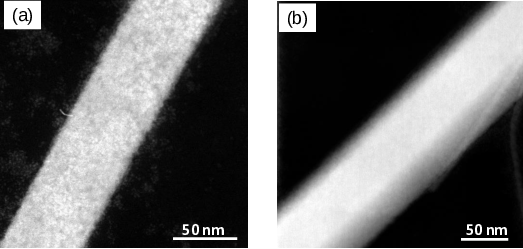
We find that an optimum plasma cleaning is a crucial step in the fabrication, which helps remove residual PVP capping layer and possible interfacial oxide, improving the interface quality and reducing the contact resistance. A careful optimization shows that Ar plasma cleaning for 20 s at a power level of and a pressure of 10 mbar results in the optimum device performance. The Figs. 1.4(a)-(b) show the STEM images of two different nanowires, one without the plasma cleaning and the other after plasma cleaning for 20 s, respectively. The plasma-cleaned nanowire clearly shows superior surface quality. The electrical characteristics of a nanowire without plasma cleaning are shown in Figure 1.5(a) at various temperatures from 7 to 200 K. The characteristics show very low current levels and fast current saturation.
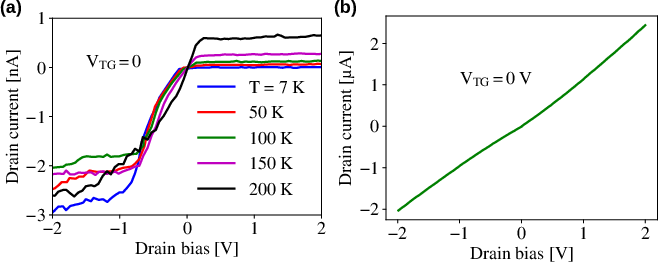
Such an observation has also been made previously for devices using two-dimensional layer materials32. On the other hand, the nanowires with plasma cleaning show a 1000-fold enhancement in the current drive at similar external bias, indicating superior contact quality as shown in 1.5(b)
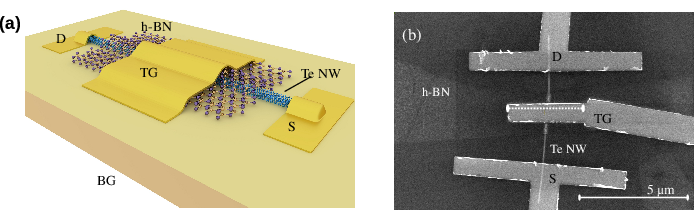
We measured several devices with a typical diameter of the nanowires chosen between 30 to 50 nm. The nanowires, with a low bandgap33, exhibit strong p-type conductivity, even without any gating. This allows us to operate the fabricated transistor as a dual-gated junctionless nanowire FET, as schematically illustrated in Figure 1.6(a). The plan view SEM image of a typical nanowire FET is shown in Figure 1.6(b). The cross-section of the device along the white dashed line is provided in Appendix [a01_01]. The transistor is normally in the on state and requires a positive gate voltage to deplete the holes from the channel (depletion mode). The top gate using the hBN dielectric controls the channel conductivity, while the global back gate can control both the channel portion, as well as the underlap regions and the metal contact region. This allows us to avoid the need for source/drain doping, and the device works as a junctionless transistor.
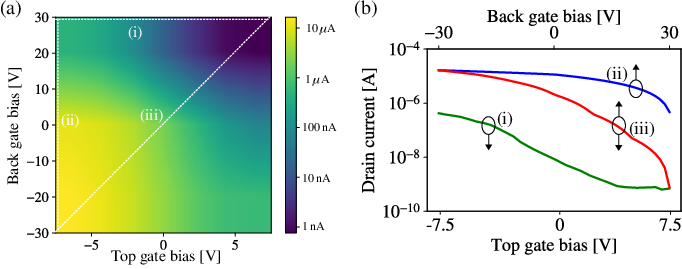
The modulation of the drain current (\(I_D\)) as a function of both the top (\(V_{TG}\)) and the bottom (\(V_{BG}\)) gate voltages is shown as a two-dimensional colour plot in Figure 1.7(a), at \(V_D=-1.2\) V. A nanowire FET, owing to the improved electrostatic control due to their cylindrical geometry, exhibits significantly improved on-off ratio compared to transistors with planar structure using tellurium nanosheet of similar thickness34. The three line cuts along the dashed lines (i-iii) in Figure 1.7(a) are shown in Figure 1.7(b). The dual-gate structure along the off-diagonal dashed line (iii) achieves superior gate control compared with stand-alone \(V_{TG}\) [along (i)] or \(V_{BG}\) [along (ii)]. Since the transistor is operated in depletion mode, the application of a negative \(V_{TG}\) and \(V_{BG}\) does not improve the drive current significantly, as can be seen from the characteristics. However, a positive gate voltage efficiently modulates \(I_D\) by depleting the holes from the channel. While the obtained on-off ratio is \(\sim 10^2\) using either the top or the bottom gate separately, we achieve an on-off ratio over \(2\times10^4\) when the two gates are simultaneously used. The results of a coupled electrostatics and carrier transport simulation from a junctionless transistor are summarized in Appendix [a01_02].
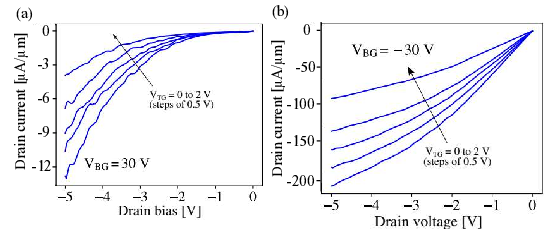
The output characteristics of the device are shown in Figure 1.8(a-b), which are obtained by sweeping \(V_{TG}\) while keeping \(V_{BG}\) at \(30\) and \(-30\) V, respectively. Since the global back gate can modulate the effective barrier to hole injection, at \(\mathrm{V_{BG}=30\,V}\), the barrier to hole injection is high, and hence the output characteristics show a predominantly Schottky behaviour. However, at \(\mathrm{V_{BG}=-30\,V}\), the barrier to hole injection is removed, and the underlap regions are electrostatically p-doped, leading to output characteristics tending towards current saturation behaviour. Thus, by changing the biasing configuration, we are able to convert the device operation from a Schottky barrier FET (SBFET) to a MOSFET. Similar architecture has previously been employed with Silicon nanowire transistors35,36 wherein a combination of a top gate and a back gate has been utilized to improve the on-off ratio. In the MOSFET mode, we achieve a high drive current of \(216\,\mathrm{\mu A/\mu m}\) (calculated using \(\frac{I_D}{2\pi r}\) where \(r\) is the radius of the nanowire) from the nanowire FET. Given the relaxed geometry used in this work, this is very promising towards high-performance scaled transistors.
A qualitative band diagram of the metal (Ni) - Te junction is shown in Figure 1.9(a) at equilibrium. The electron affinity of Te \(\chi_{Te}\approx 4\,\mathrm{eV}\)34 and Ni has a work function \(\phi_{m}\approx 5\,\mathrm{eV}\). The p-type conductivity suggests that the Fermi level in Te is near the valence band, and thus we can see that \(\phi_{m}\gg\phi_{s}\) where \(\phi_{s}\) is Te work function. This allows the holes to move freely across the contact interface without any Schottky barrier and is ideal for an excellent ohmic contact37.
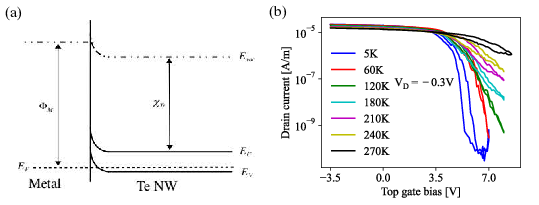
To analyze such contact barrier-free operation in the MOSFET mode, we measure the temperature-dependent device characteristics keeping the bottom gate floating and varying \(V_{TG}\) and \(V_D\). The transfer characteristics of the device from 5 to 270 K are shown in Figure 1.9(b). It is striking that under on condition (\(V_{TG}<0\)), \(I_D\) is a very weak function of temperature, even down to temperatures as low as 5 K, and \(I_D\) increases with a reduction in temperature (due to a subsequent increase in hole mobility, as discussed later) - clearly suggesting barrier-free hole injection from the contact.
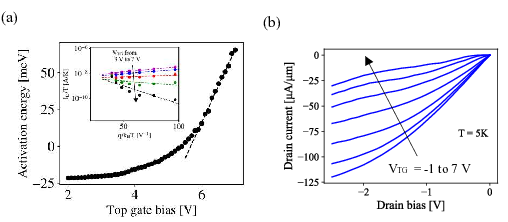
We further verify this using a modified Richardson equation for nanowire38 in Figure 1.10(a), wherein the inset, we plot \(\frac{I_D}{T}\) in the log scale as a function of \(\frac{1}{T}\) at various \(V_{TG}\). The effective barrier height, as extracted from the slope of the linear fits, is shown in Figure 1.10(a). The positive slope (and hence the ‘negative’ effective barrier) under on state is due to a reduction in \(I_D\) with \(T\), representing a negligible barrier at the contact interface. This is independent of \(V_{TG}\) as the top gate only controls the channel portion. At larger positive \(V_{TG}\), the extracted effective barrier increases, which corresponds to the \(V_{TG}\) induced potential barrier created between the source underlap and the channel as the channel turns off. The output characteristics of the device shown in Figure 1.10(b) further support the negligible Schottky barrier even at \(T=5\,K\). The characteristics show strong current saturation, particularly at relatively low \(|V_{TG}|\), and \(I_D\) varies approximately in a quadratic manner with \(V_{TG}\).
Using the temperature-dependent transfer characteristics, we extract the field effect mobility (\(\mu\)) of the nanowire FET as10,39 \[\mu=\frac{dI_{D}}{dV_{TG}}\frac{L_{ch}}{C_{ox}}\frac{1}{V^\prime_{D}}\] Here \(C_{ox}\) is the gate capacitance per unit length of the device, \(L_{ch}\) is the channel length of the device, and \(V'_{D}\) is the effective drain bias after correcting for the series resistance. Since the gate does not entirely cover the device, there are significant underlap regions, which contribute to the series resistance. This effect can be seen in output characteristics shown in Figure 1.10(b) where at high \(|V_{TG}|\), the rate of increase of current with \(V_{TG}\) decreases, indicating that \(I_D\) is limited by the series resistance. The total series resistance is estimated as \[R_{s}=R_{D}\frac{L_{under}}{L_{wire}}\] where \(R_D\) is the output resistance in the linear regime with \(V_{TG}\approx 0\), \(L_{wire}\) is the total length of the nanowire and \(L_{under}\) (\(=L_{wire}-L_{ch}\)) is the total length of the underlap regions. The corrected drain bias then becomes \[V^\prime_{D}=V_{D}-I_{D}R_{s}\] where \(V_{DS}\) is the applied drain bias.
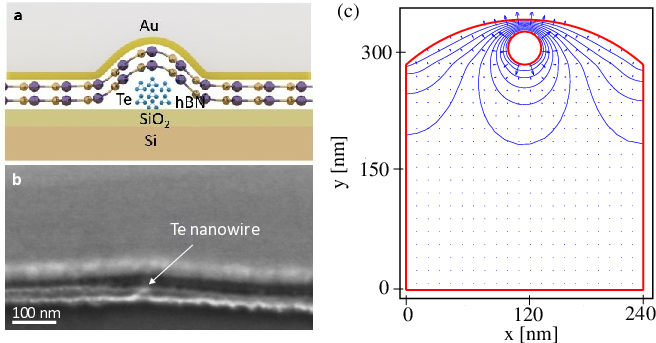
The channel being cylindrical in nature, \(C_{ox}\) is very sensitive to device geometry and can vary up to 10-fold if the correct device structure is not taken into account40–42. The cross-sectional geometry of the device and the corresponding scanning electron micrograph are shown in Figure 1.11(a-b). To accurately capture the gate capacitance, the Laplace equation is solved for this device geometry \[\frac{\partial^{2}\phi}{\partial x^{2}}+\frac{\partial^{2}\phi}{\partial y^{2}}=0\] using finite element method (FEM) as implemented in FreeFEM++ software43. The nanowire is assumed to be conducting and hence is equipotential with Dirichlet boundary conditions \(\phi=V\). The top surface of hBN is assumed to have fixed potential at \(\phi=0\). Since the bottom gate in the measurement is left floating, the electric field at the bottom of 285 nm \(\mathrm{SiO_{2}}\) is assumed to be zero. The total charge (\(Q\)) on the nanowire is calculated by integrating the normal component of the electric field on the nanowire. The gate capacitance is then obtained from \(C=\frac{Q}{V}\). The electrostatic potential contour lines and the corresponding electric field lines, as obtained from the 2D FEM simulation, are shown in Figure 1.11(c). Due to the relatively larger diameter of the nanowires used in this work, we have neglected the quantum capacitance of the channel44–46 arising from the finite density of states. This quantum capacitance comes in series with the gate oxide capacitance calculated above. This results in a slight overestimation of the gate capacitance, hence underestimating the extracted carrier mobility. Thus, the extracted hole mobility values discussed next represent the lower bounds of the true mobility.
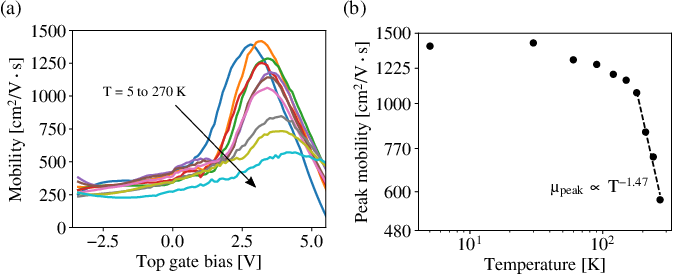
The extracted \(\mu\) is shown in Figure 1.12(a) as a function of \(V_{TG}\) at different \(T\). \(\mu\) has a peak (\(\mu_{peak}\)) near the threshold voltage, where it shows strong temperature dependence. On the other hand, at higher negative \(V_{TG}\), it drops due to large gate field47, and the strong temperature dependence vanishes. The nanowire FET exhibits \(\mu_{peak}=570\,\mathrm{cm^{2}/V\cdot s}\) at 270 K, which is twice of (110) Si hole mobility, and also beats the state-of-the-art uniaxially compressed (110) strained Si hole mobility4. \(\mu_{peak}\) increases monotonously with a decrease in the temperature initially and gradually saturates to a value of \(1390\,\mathrm{cm^{2}/V\cdot s}\) at low temperature [Figure 1.12(b)]. For \(\mathrm{T>180\,K}\), \(\mu_{peak}\) can be fitted to a power law: \[\mu_{peak}\propto T^{-\gamma}\] with \(\gamma=1.47\). This indicates that for \(\mathrm{T>180\,K}\), \(\mu_{peak}\) is limited by phonon scattering, while at lower temperatures, it is limited by Coulomb scattering48,49. For solution synthesized Te nanoflakes, \(\gamma\) has been found to be 1.0350 while in Te thin films grown by molecular beam epitaxy, \(\gamma\) is found to vary between 0.75 to nearly zero51.
A comparison of the performance of the presented Te nanowire transistor with other reported Te-based transistors16,17,34,50–52 is shown in Figure 1.13(a-b) in terms of drive current and on-off ratio. To make a fair comparison by accommodating varied device dimensions and biasing conditions in reported data from the literature, we scale the drive current (\(I_{ON}\)) by the drain field and the circumference of the nanowire (channel width in case of 2D flakes) as follows: \[I_{scaled} = \frac{I_{ON} L_{wire}}{2\pi r V_{DS}}\]
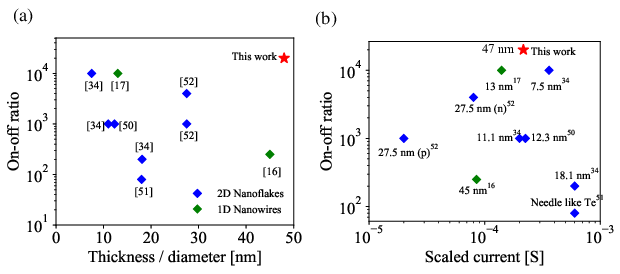
Previous reports suggest that Te exhibits high mobility for thicker films (and wider nanowires); however, it becomes challenging to turn the channel off at such channel thickness. On the other hand, for thin channels, where the on-off ratio is improved, the carrier mobility degrades significantly, and Te loses its attractiveness as a high-mobility channel. Figure 1.13(a) shows the on-off ratio achieved in various Te-based transistor structures reported earlier as a function of the channel thickness (or diameter), suggesting a strong degradation of the on-off ratio for thicker channels. From the same figure, we observe that the advantage of the improved electrostatics due to dual-gated nanowire structure in the present work is remarkable, allowing us to achieve an on-off ratio of \(2\times10^4\) (\(@V_{ds}=-1.2\) V) at a relatively larger nanowire diameter. However, the device’s subthreshold swing is still relatively large, and there is scope for further optimization on the gate electrostatics and nanowire-dielectric interface. In Figure 1.13(b), we compare the performance of different reports in the on-off ratio and drive current space. We note from the figure that the present work provides comparable performance with the best reports in terms of drive current while maintaining a superior on-off ratio.
In summary, we presented the synthesis, fabrication, and electrical characterization of high-performance dual-gated p-type Te nanowire junctionless transistors. The unique combination of contact-barrier-free hole injection, high hole mobility (\(570\) and \(1390\,\mathrm{cm^{2}/V\cdot s}\) at 270 and 5 K, respectively), dangling-bond-free, clean interface between the nanowire channel and hBN dielectric, and dual-gated operation allows us to achieve an on-off ratio in excess of \(2\times10^{4}\) with a high on-current of \(216\,\mu A/\mu m\) even at a relatively small drain field, which is superior to existing p-type nanowire FETs. Te nanowires are thus a promising candidate for next-generation ultra-scaled transistors, as well as for other nanowire-based electronic applications, including highly scaled memory, biosensing, fast infrared sensing, and spectroscopy.